
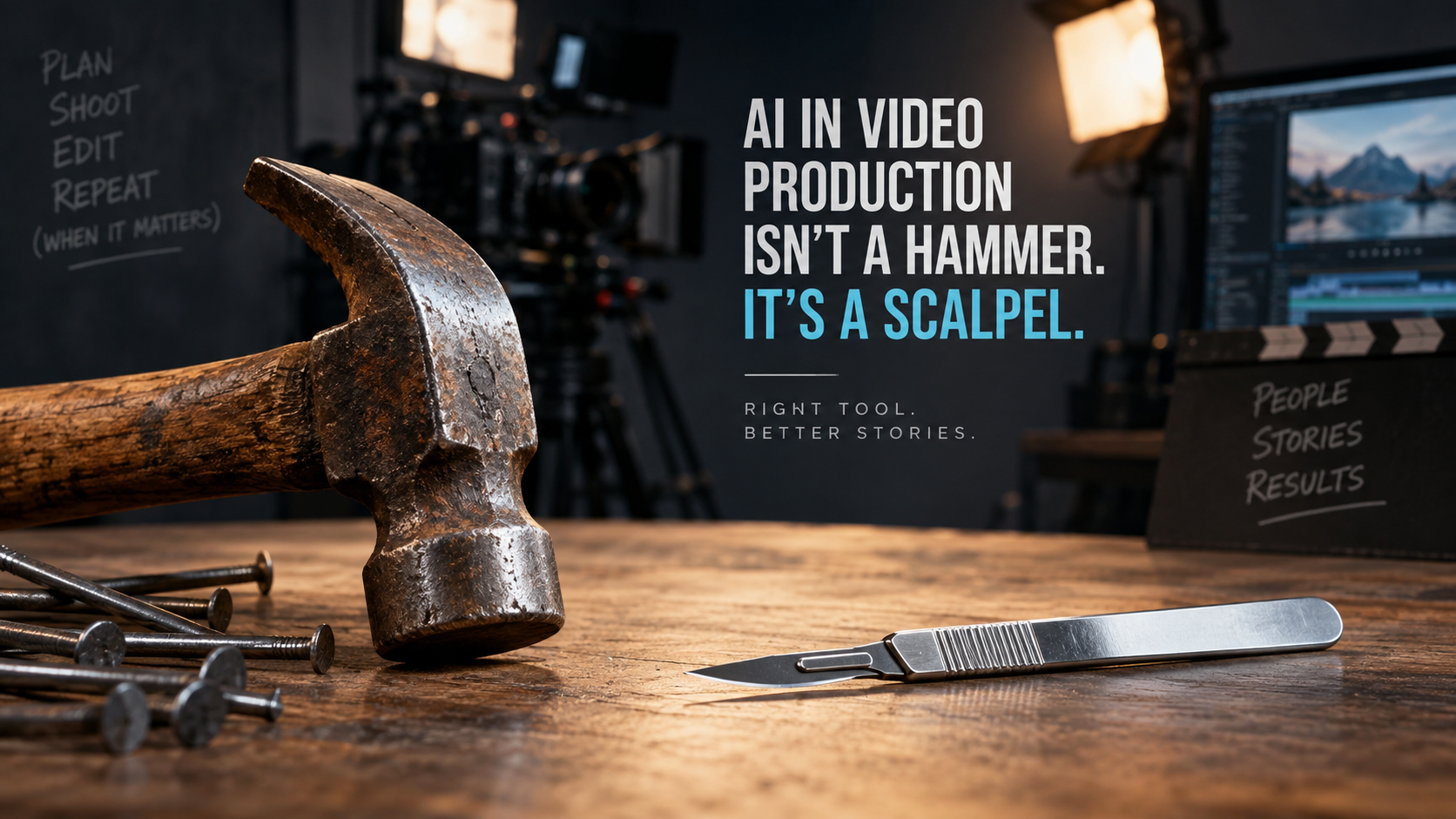
I love a good hammer. But hammers have a problem. When you have a hammer, everything starts looking like a nail.
I think we're seeing something similar with AI in video production. Because AI can do an astonishing number of things now, it's tempting to use it everywhere.
Generate the script, voice-over, talent and B-roll footage. Cut the edit.
Done!
But is that actually better? Have you tried it?
If so, then like me, you probably agree that it isn’t. It generates AI slop.
I think AI in video production is less like a hammer and more like a scalpel. Its real value isn't in using it everywhere. It's in knowing where it can improve the work.
At The UnMarketing Group, we've been using AI in some very specific, surgical ways. For example:
ADR and voice replacement
Sometimes a line in an interview or presentation needs replacing. In the past, that might mean bringing someone back into the studio, setting everything up again, and recording a single sentence. Used carefully, AI can replace that small piece without recreating the entire production.
That's not replacing the performance. It's fixing a specific problem.
Dialogue isolation and noise reduction
AI has become remarkably good at separating a voice from unwanted background noise. But I don't want AI to "fix" everything. I want it to make the smallest intervention necessary to improve the recording while preserving the strength of the performance and the voice's natural character.
That's an incredibly important distinction.
Selective VFX
AI can now remove, repair or modify things that previously would have required considerably more time and specialized visual-effects work. Again, I'm not interested in generating an entire scene because I can.
If there's one small problem in an otherwise good shot, that's where the scalpel comes out.
Multilingual video
This is one of the most interesting applications we've used. We've created multiple language versions of training content using AI-assisted dubbing when producing separate versions with different voice talent, recording sessions and editing simply wasn't economically practical.
That doesn't mean AI dubbing is the right answer for every project. For a national advertising campaign where performance, nuance and cultural localization are critical, I'd still push for professional voice talent and a properly localized production. But for certain internal training applications? The economics are different.
The fact is, when done right, AI can make something practical that previously wasn't practical. But just like every tool and technique we use, it must serve the story.
And I think that's an important way to think about AI in production. Because there are still plenty of things I don't want AI doing.
I want a real person interviewing your subject-matter expert.
I want someone who can recognize when an interviewee has just said something interesting and ask the next question.
I want someone who understands why a particular camera angle works.
I want someone listening to the room before the cameras roll and realizing that the HVAC system is going to ruin the interview.
And, yes, I want someone who knows that good sound isn't something you can reliably fix after the fact.
Those aren't inefficiencies waiting to be automated. They're part of the craft.
And here's the irony:
As AI makes some things easier and cheaper, it also makes creating professional-looking video easier and cheaper. I think that makes the things that make video effective even more important.
The story.
The expertise.
The credibility.
The human connection.
The reason the video exists in the first place.
AI can help us make those things more efficiently. But it can't decide whether they're worth saying.
That's our job.