
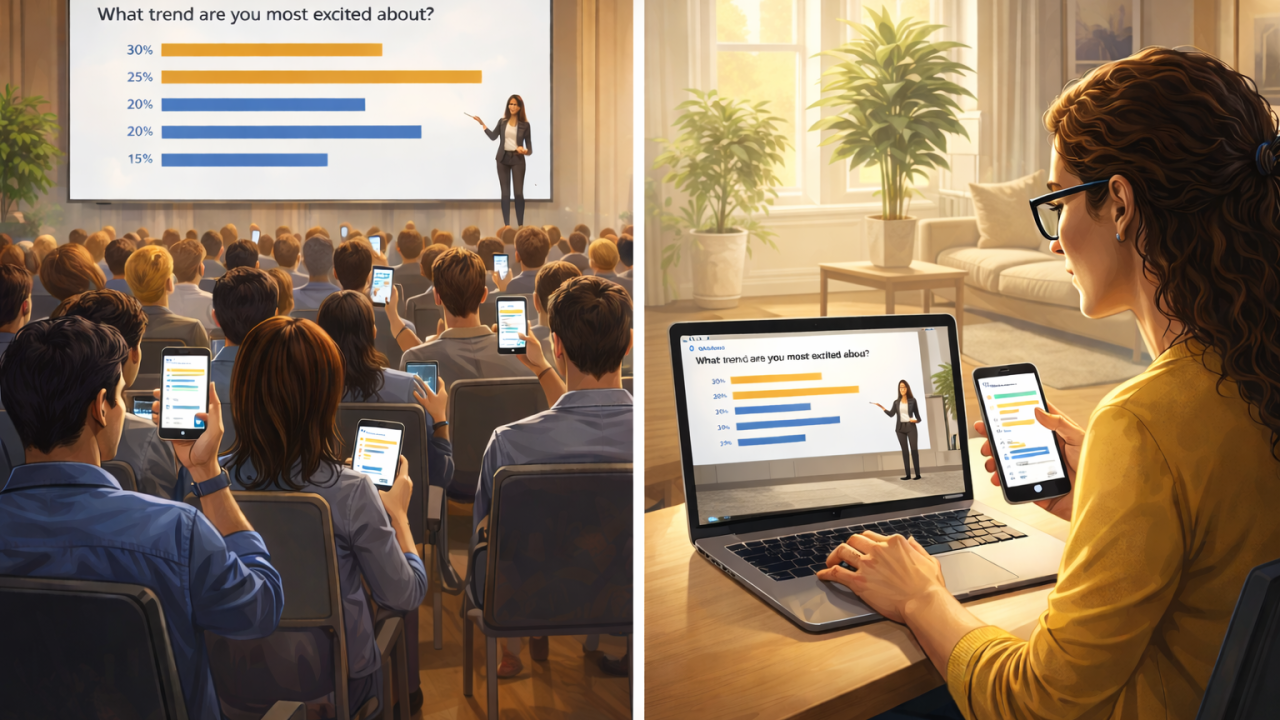
I spend a lot of time standing at the back of event rooms (that sounds creepy, right?).
Sometimes those rooms are packed with people. Sometimes they’re split between a room and a livestream. Sometimes they’re entirely virtual, and I’m in my PJs (too much sharing?).
Different formats. Same lesson.
The sessions people remember aren’t always the slickest or most polished. They’re the ones where the audience feels heard—and sees their input shape the conversation.
Engagement Increases When Participation Is Designed In
Participation works best when it’s:
Part of the session (not just Q&A at the end)
Low-friction
And clearly connected to what happens on stage
A quick poll or sentiment check early on gives speakers context and gives audiences a reason to lean in.
Tools like Mentimeter, Poll Everywhere, and Slido work well here because they’re fast, familiar, and phone-friendly — across in-person, hybrid, and virtual events.
So, why are these such powerful tools?
Not Everyone With A Great Question Wants a Microphone
In every audience, some people are comfortable walking up to a mic.
Many aren’t — even if they have a great question.
When participation depends on public speaking, you’re hearing from confidence, not necessarily insight.
Anonymous or low-pressure input (polls, upvoted questions, chat) brings in perspectives you’d otherwise miss. This is where these tools quietly shine.
Please (Don’t) Put Away Your Phone
Phones aren’t the enemy. They’re already how people multitask while listening.
Using phones intentionally — for polls, reactions, or questions — channels that behaviour instead of fighting it.
Done well, it increases focus rather than distracting from it.
Let the Audience Shape the Discussion
Some of the strongest panels I’ve seen do this:
Take a quick audience pulse
Identify agreement or skepticism
Have the moderator frame questions that reinforce or challenge that sentiment
Suddenly, the panel isn’t answering abstract questions — it’s responding to this audience.
A simple, fun version of this is Myth Busting:
Present a statement
Poll the audience
Show the results
Let the panel confirm or blow it up
Either way, people stay engaged because the discussion started with their thinking.
Don’t Treat Live Chat as a Backchannel—Curate It
Live chat shouldn’t be a side conversation that the stage ignores.
Used well, it becomes a shared space where audience members react, clarify, and build on each other’s ideas — in real time.
With light moderation:
Themes emerge
Strong points rise
And select comments can be surfaced on screen to move the discussion forward
The goal isn’t to read the chat. It’s to fold audience dialogue into the session without letting it drift off track.
Keep It Simple
If participation tools are:
Hard to explain
Hard to integrate into AV
Or expensive
They won’t get used consistently. The best engagement approaches are simple, affordable, and work equally well for in-room and remote audiences.
A Final Thought
Audiences are smart. They’re curious. And they want to contribute — if we invite them in.
For your next event, ask: “How do we let the audience influence the conversation?”
If you’re designing events and thinking along those lines, I’m always happy to chat. Sometimes a small shift in participation changes everything.
Norm Clare